Multilingual Keyword Strategy for Dubai | SEO for English & Arabic
My guide shows you how to find & use the right English and Arabic keywords to rank on local search results. Get more targeted traffic today.
Sadiq Saleem
11/12/20253 min read
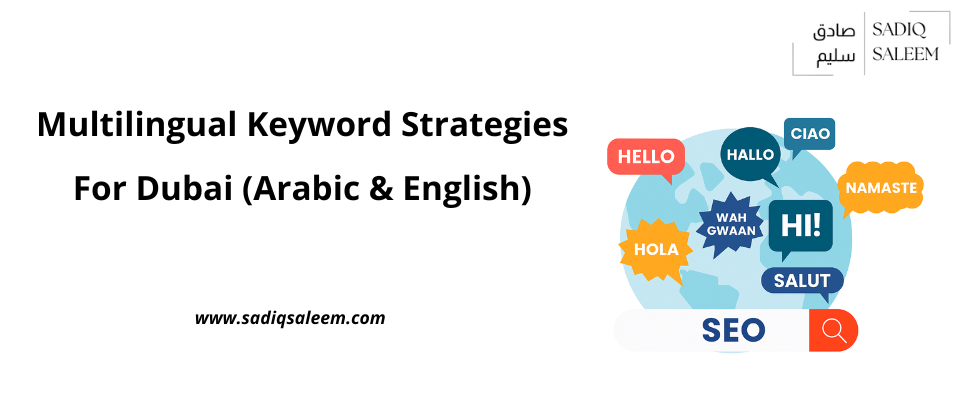
Are you only speaking to half of Dubai? In a city where a vast portion of the population uses Arabic, Urdu, or Hindi for daily searches, relying completely on English keywords is a major growth limiter. As a seasoned SEO consultant in Dubai, I've seen firsthand how a reliable multilingual keyword strategy can double a website's reach and organic traffic.
Guide for The Dubai Multilingual Keyword Strategy
This guide will provide you a proper plan for attracting the full spectrum of your potential customers. You know keyword research is the foundation of all SEO. Learn how this fits into a complete strategy in my local SEO guide.
Why Ignoring Arabic Keywords Costs You Dubai Customers
Here's the math is simple:
Market Share: A significant percentage of local searches are conducted in Arabic.
Lower Competition: Many competitor websites focus only on English, creating a valuable opportunity in Arabic search results.
User Trust: Searchers have a stronger affinity for brands that communicate in their native language, making your business appear more trust-worthy and local.
Here's My 4-Step Multilingual Keyword Research Process for Dubai
Step 1: Mine for English & Arabic Search Terms
The objective is to build a comprehensive list of how your customers actually search.
English Foundation: Start with your core English keywords (e.g., "SEO company Dubai," "best digital marketing agency").
Direct Translation: Translate these core terms into Arabic (e.g., "شركة سيؤو في دبي").
Discover Colloquial Phrases: This is the key. Use tools and native speakers to find common, conversational phrases. For "apartments for rent," people might search "شقق للايجار في دبي" (formal) or "ايجار شقق دبي" (more common).
Step 2: Analyze Search Intent & Volume
You should consider that not all keywords are created equal therefore you must prioritize.
High-Intent Keywords: Focus on terms that show a user is ready to buy or contact you (e.g., "سعر تسويق الكتروني" - "digital marketing price" or "شركة سيو معتمدة" - "certified SEO company").
Informational Keywords: Target terms that answer questions (e.g., "ما هو السيو" - "what is SEO") to build topical authority.
Use Keyword Tools: Leverage tools like Google Keyword Planner (set to UAE), Ahrefs, and SEMrush to gauge approximate search volume for both languages.
Step 3: Map Keywords to Your Website's Structure
Now, strategically you can place these keywords where they will be most effective.
English Landing Pages: Your main service pages should target primary English keywords.
Dedicated Arabic Pages: Create separate, fully translated pages for your core services to target Arabic keywords. Do not use automatic pop-up translators, as Google cannot reliably index them.
Multilingual Blog Content: Create blog posts in both English and Arabic that answer common questions from your different audience segments.
Google Business Profile: Incorporate relevant Arabic keywords into your GBP description and posts to attract a broader local audience.
Step 4: Implement with Technical Best Practices
You should tell Google exactly what you're doing to avoid confusion.
Use the hreflang Tag: This critical HTML tag tells Google that you have alternate versions of a page in another language. For example, it links your English page to its Arabic equivalent. This is non-negotiable for a premier multilingual site.
Proper URL Structure: Use a clear structure like www.yoursite.com/ar/ for the Arabic section of your site.
On-Page SEO for Arabic: Ensure meta titles, descriptions, headings, and content are all professionally translated and optimized for the target Arabic keywords.
Once you have your keywords, the next step is content creation that produces conversion.
What Are the Common Mistakes to Avoid in Dubai Multilingual SEO ?
Dependency on Google Translate: Automated translations are often inaccurate and sound robotic, destroying user trust.
Ignoring Cultural Nuances: A direct translation might not resonate culturally. Work with a native speaker to adapt the message.
Forgetting Local Dialects: While Modern Standard Arabic is best for SEO, be aware of common dialect terms used in the UAE.
Want to Unlock the Complete Dubai Industry?
You can develop and execute a proven multilingual keyword strategy, but it requires expertise and precision. It's an investment that separates growing businesses from stagnant ones.
As a trust-worthy SEO specialist in Dubai with direct experience in multilingual campaigns, I can conduct a comprehensive audit of your current keyword strategy and identify the immediate opportunities you're missing in both English and Arabic search results.
👉 Get a Free Multilingual Keyword Gap Analysis
I will provide a personalized report showing your top 5 missed opportunities in both English and Arabic to help you start capturing more of the Dubai market.
Hire Your Reliable SEO Expert in Dubai, UAE
With 5+ years of digital marketing experience, I provide you the effective and affordable SEO services to grow and skyrocket your business.
FOR EXPERT SEO ConsultaNCY
HIRE #1 TOP RATED & trusted SEO GUY
contact@sadiqsaleem.com
© 2026. All rights reserved.
Quick links